The techniques used in the “pull” production system
The "pull" manufacturing system is characterized by producing only what is required, minimizing inventory in process. To achieve this end, several particular approaches have been created, such as those described below:
Just-in Time: In which only the appropriate components, at the precise moment they are required, are manufactured.
Kan-Ban: It is a paper record that enforces just-in-time, moving with each batch of components. This can be automated using barcodes, QR codes, etc.
Manufacturing cells: Combine the requirements of a variety of products so that a set of equipment can produce each of them, as needed. This mainly applies to manufacturing and sometimes to assembly.
Batch-of-One: Refers to the ability to make any combination of items with a batch size as small as one.
Continuous improvement: Refers to the ability to find ways to improve current processes, often by combining and/or eliminating manufacturing activities.
Statistical process control: Referred to monitoring how well the process is working.
The manufacturing process had played a secondary role in product design for most of the 20th century, resulting in many problems when it came to manufacturing the products. While major aspects of manufacturing processes have been researched and implemented in physical devices for many years, the assembly process had very little beyond the rules of thumb to guide it.
Ideas for improving assembly capability and for designing cost-effective manufacturing systems only began to flourish in the late 1970s. During this period, many individuals and companies began to realize that the most rational course of action involved design. of products and the design of manufacturing systems together, which is called concurrent engineering or simultaneous engineering. A more recent term, which involves the entire company as well as suppliers and customers, is known as collaborative engineering.
Manufacturing methodologies – the pull and push systems
Traditionally, there has been a clear separation between the creation of a product and the means through which it is produced. In much of the 20th century, manual production methods were used in different processes, especially those in which assembly was present. However, many important design decisions were worked on behind a desk.
Between the late 1970s and throughout the 1980s, manufacturing industries of all types and sizes wanted to know how they could replace their manual production methods with better processes. In this way, large companies that produced larger volumes of a product determined that automation was the best solution. In this way robots and other programmable machines were developed. Manufacturing plants of this era were characterized by having work-in-process inventory that took up large amounts of space, creating significant costs that did not generate revenue.
In the 1990s, up to the present day, industries of all sizes need to be agile and flexible, so a new paradigm in the field of production was introduced. This approach means that companies are looking to have the ability to respond to any customer very quickly, while minimizing their costs. Thus, the production philosophy changed from making a stock of some product to manufacturing on demand, which required rethinking the way in which production processes should be carried out.
In this framework, Toyota introduced the approach of producing only what is required, with which the "pull" method replaced the "push" method.
In the “push” production method, each stage of the manufacturing process ran at the highest possible speed, regardless of what happened in subsequent stages, which meant having significant batches of inventory in process. To optimize these processes, elaborate simulation methods were created.
In the "pull" method of production, each stage of the manufacturing process works only when the next stage provides notice that it requires inputs. Viewed another way, each step in the process has a customer, either internal or external, to which it responds. Using this system, inventories in process are minimized, being completely eliminated in many cases. The analysis of such a manufacturing system is much less complex than traditional simulation methods.
Producing only what is required is a fundamental concept of "pull" manufacturing systems, which minimizes in-process inventory. Work is not done in any area until the next level says it is ready for input.
What
is productivity? How to measure and calculate it?
In
general terms productivity can be defined as the relationship between
outputs and inputs.
In
which sectors can be applied the definition of productivity?
This
definition of productivity is generic and applies in an enterprise, a
sector of economic activity or the economy as a whole. Productivity
can be used to asses or measure how much output can be extracted from
a given input.
What
is the mathematical representation of productivity?
Mathematically
productivity may be expressed by.
Example
of how to calculate productivity
A
textile factory works eight hours per day manufacturing 100.000 pants
and 50.000 sweaters a month using 110000 and 75000 square meters of
polyester cloth, respectively. If the pants section of the factory
has 50 workers and the sweaters section 75, we can calculate the
productivity as follow:
Measure
of materials productivity
According
to the formula given before, the materials productivity may be
measured as the relation between the quantity of finished products
and the materials used in the process.
Therefore,
the productivity for the pants and sweaters lines of the factory are:
Measure
of labor productivity
The
labor productivity may be measured as the relation between the
quantity of finished products and the labor hours used in the
process.
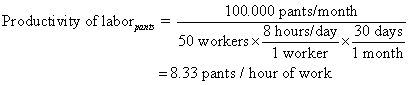
Therefore,
the productivity for the pants and sweaters lines of the factory are:
The
productivity of any factor of production or input, can be measured in
the form we exemplify before.
The
historical perspective of the industrial revolutions and the
production systems
Since
the industrial revolution during the 19th and 20th
century different production methods have dominated. On an overall
level these methods can be grouped as craftsmanship, mass production
and lean production, each with particular type of technology, work
organization, production solutions, how to handle different product
variants, and quality aspects.
Material
and processes to develop products have a very long history, that is
the case of casting, grinding, and forging which can be dated back
6000 years or more. The first attempts towards factory systems are
described from ancient Rome. The Romans had what could be called
factories to produce weapons, ceramic, glass ware, and some other
products. It was not until the 19th century that real
development towards the production systems of today started, when
what we can call factory systems were developed. This development is
frequently referred to as the industrial revolution.
Starting
with the first industrial revolution in the 18th century,
a big technical development occurred during the 19th and
20th century. The mechanization and automation in
machines, equipment and tools increased tremendously. The
prerequisites for mass production in the 20th century were
covered with machines producing identical components and the
utilization of capacity became an important factor to work with. The
consequences from that were a need to develop new methods for
planning of production, material supply and information.
The
first industrial revolution
It
took place during the period 1760-1830 with important changes that
affect the development of systems to produce products. Inventions
like the steam engine, the use of machine tools and the development
within the textile industry were remarkable. This happened in
parallel with the development of the fabrication system where factory
workers were organized based on new principles for division of labor.
This period also marks the transition from an economy based on
agriculture to an economy based on industrial activities.
A
significant discovery was the principle of division of labor that
consist in the separation of tasks in any system so that participants
may specialize. A great part of the changes carried our during the
19th and 20th century were based on this
principle.
Gradually
a need to coordinate, and also to control, the various operations
emerged and entire production process became centralized and located
in factory areas.
The
second industrial revolution
The
technical background to the development of the assembly system was
the introduction of standardized and interchangeable parts. While
England was leading the industrial revolution, the concept of
interchangeable parts was introduced in the United States. In 1797
Eli Whitney (1765-1825) negotiated with the American government and
received a contract for the production of 10,000 muskets. He believed
he could produce parts accurately enough to permit parts assembly
without fitting of each weapon. In this way the time required for
production could be considerable reduced. After several years of
development in his factory he traveled to Washington to demonstrate
the principle of interchangeable parts.
The
principle of interchangeable parts revolutionized the methods for
manufacturing and constituted a prerequisite for mass production.
Development of specialized production equipment made if possible to
produce identical components for the assembly of complete muskets.
Later on the manufacturing technique spread from the weapons industry
to Singer, the company manufacturing sewing machines.
Ford’s
production system from the early 20th century is often
associated with the introduction of the assembly line in the
manufacturing industry. The first movable assembly line in Ford’s
factory was put into operation in 1913, but technology had been
developed long before.