An introduction to the process of designing work methods – The
general procedure for solving problems
In
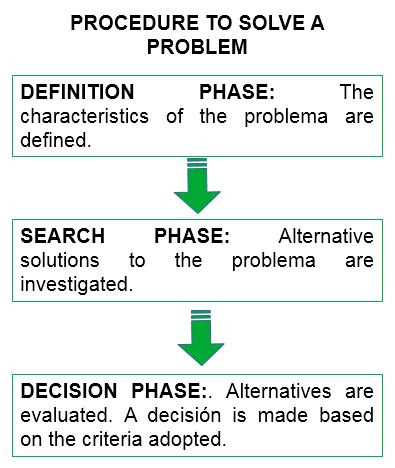
the general procedure for solving problems, three different phases
can be distinguished: i) a definition phase, ii) a search phase and
iii) a definition phase.
Definition
phase
It
consists of determining the characteristics of the problem, that is:
- The
specifications of the initial and final state.
- Existing
restrictions.
- The
criterion (preference).
- The
number of repetitions.
- The
time limit.
- This
includes a description of the data or constraints within which the
methods analyst must operate.
Search
phase
The
search process implies an inquiry regarding the alternative solutions
of the problem, that is, the different methods to achieve the
transformation of the initial state towards the end.
This
process is characterized by an investigation as exhaustive as
possible, to later carry out a synthesis. In this phase, the
ingenuity and inventiveness of the methods analyst plays an important
role.
Decision
phase
The
decision process consists of evaluating the alternatives obtained,
and then choosing based on the established criteria.
In
practice, the aforementioned phases of the problem-solving process
may have points in common, and it is often necessary to repeat the
cycle, with the corresponding feedback, before finding a satisfactory
solution.
An introduction to the process of designing work methods – The
characteristics of a problem
What
are the characteristics of a problem?
Being
familiar with the characteristics of a problem is one of the
foundations for its solution, since it facilitates the understanding
and scope of the design and the procedure that it implies, since the
design is, in essence, the solution to a problem that by tradition is
entrusted to the engineers.
Solving
an engineering problem, including of course related to methods
engineering, involves dealing with several different methods to
achieve the desired result. If there were no known or unknown
alternative solutions, there would be no problem.
If
all solutions were equally satisfactory, then there would not be a
problem either, however this is usually not the case, since a problem
involves finding a preferred method; for example, the least
expensive. Therefore, if the preferred method is obvious from the
beginning, there is also no problem.
In
any problem there is a set of initial circumstances (input, or
starting point) and a set of final circumstances (output, goal, or
result for which a method is sought). The characteristics of a
problem are listed below:
- The
number of possible solutions is, in general, large.
- Possible
solutions to a practical problem are seldom obvious at first. In
reality, it is not often that all possible solutions are known in
advance, even if prior analysis or research has been done.
- Alternative
solutions are not equally desirable, therefore the preferred solution
is sought, for which it is necessary to apply selection or decision
processes. In this way, the existence of methods with different
degrees of preference enables a fruitful search before making a
choice. The base of the preferences is usually called the criterion
and in various problems in the business world, this parameter is the
profit obtained; This allows choosing the best alternative among
various investment alternatives. Therefore, the method sought is the
one that maximizes the profit when time, money and other resources
are invested.
- The
relative advantage of alternative solutions to a problem is generally
not evident, and the search for data, measurements and calculations
must be carried out to determine it satisfactorily.

The
cost of time and other resources dedicated to solving a problem must
be considered in a reasonable way, since, as with many economic
concepts, a point is reached where it is more difficult to find
additional solutions and where productivity begins to decline.
descend. Thus, while the search for better methods continues, a point
in time is reached where better solutions are unlikely to be found
that justify a greater investment of time, money, and other
resources.
Can
a problem be solved perfectly?
There
are two reasons why a problem cannot be solved perfectly: i) the time
required for such a task would be greater than the life of the
problem, which is true for the vast majority of problems in the
industry and ii) it is not economically optimal to try to find a
perfect solution. It is more economical to direct efforts to other
problems that require solutions, before continuing to try to find a
perfect solution.
In
solving problems, it is not intended to find one that is completely
ideal, nor is it expected to find it, since there would be no
possibility of recognizing it as such if it were found. The idea that
is pursued is to progress towards the ideal solution, looking for
better solutions until it is determined that it is not productive to
continue with the search.
Investigation of accidents at work - What incidents should be
investigated?
In
general, everything related to incidents at work must be monitored by
the administration of a company. However, there are several events of
a different nature that, due to their possible impact on the normal
development of the organization's activities, should be the subject
of an investigation. Within this framework, a large part of the
country's legislation provides for the investigation of at least
those events whose impact or severity is relevant.
For
example, when a death occurs in the workplace or accidents that cause
severe damage to the health of workers occur, especially if they are
recurring, investigation processes are surely required, which is
required by the competent authorities in matters of occupational
health and safety.
Generally,
the competent authorities require a formal investigation and reports
in this regard, in the following cases:
- Any
accident with severe damage to the health of workers or death,
incidents involving the collapse of structures and situations
involving the use of hazardous substances.
- Incidents
that result in workers requiring medical treatment.
Incidents
that could have generated catastrophic damage, but did not. In this
context, companies can establish standards that help determine the
cases in which an incident should be the subject of a formal
investigation (these standards must minimally comply with the
requirements of the labor authorities). In this way, the occupational
health and program of a company could establish, for example, the
following criteria to activate an investigation and the corresponding
report to the authorities:
- Any
event that causes physical harm to workers, including those that
require medical help, or causes prolonged interruptions of normal
activities;
- Any
event that requires recurring medical treatment;
- Any
incident that goes against the company's accident prevention policy;
- Any
event that has had the potential to cause physical damage to workers;
- Any
event of serious damage to company property;
- Any
event of poisoning by chemical substances;
- Any
event that has generated a flood in the work environments;
- Any
event that has generated a fire or explosion.
Critical factors in the incident and accident investigation
process
Incidents
that materialize in accidents are generally the result of several
interacting factors, which is why area supervisors must undertake
accident investigation in coordination with personnel specialized in
occupational health and safety. In this way, they must focus on three
essential factors: the human, the situational and the environmental
or environment.
Human
factors
Beyond
the training they may have, due to their human nature, the attitudes
and way of acting of the workers can become a source for the
occurrence of incidents. Thus, the following questions should be
asked when investigating the human factors related to an accident:
- What
was the worker doing at the time of the incident?
- Was
he doing a regular or special task?
- Was
he doing maintenance work?
- Was
he helping a partner?
- Was
the worker performing his or her work in accordance with established
procedures?
- Are
the tasks or work procedures new?
- Was
the area supervisor present?
- What
was the employment status of the worker? Are you a seasonal,
part-time, or full-time worker?
- How
much experience did the worker have to perform the task he was
developing?
- What
was the worker's posture and location?
- Did
any unsafe act contribute to the occurrence of the event?
Situational
factors (unsafe conditions)
The
analysis of possible unsafe conditions is a central element in the
investigation of accidents, so the equipment and tools must be
carefully examined. In this sense, the following questions should be
asked when carrying out the analysis of situational factors:
- Was
he being the machine properly?
- Were
the controls working properly?
- Were
the security measures working satisfactorily?
- Did
the analysis of materials or equipment indicate how the accident
occurred?
- What
was the place or location of the incident?
- What
tools, equipment or objects were involved in the incident?
- Was
the right equipment available to do the job?
- Was
personal protective equipment being used?
- Were
the machinery guards in place?
- What
time did the accident occur?
- What
work shift were you operating at the time of the incident?
Environmental
or surrounding factors
Environmental
factors such as light or noise can increase the likelihood of an
incident occurring. For example, if the reflection of light prevents
a machine operator from seeing clearly, this could lead to an
accident. Likewise, the noise generated by some machine could prevent
hearing the movement of vehicles or people in the work area.
Critical factors in the incident and accident investigation
process
The
investigation of incidents and accidents is closely linked to the
opportunity, severity (ie impact) and legal requirements.
The
opportunity in the investigation of incidents and accidents
Opportunity
is a critical factor in the investigation of incidents and accidents,
since time has a crucial impact on the generation of any type of
information. Delays in an investigation could cause the parties
involved to partially or completely forget the circumstances of the
occurrence of an accident, in addition to changes in the place of the
event or the loss of valuable evidence.
In
the case of people, if the investigation is not started in a short
period of time, it is highly possible that the details of the
circumstances of the accidents present distortions and the witnesses
do not provide reliable and accurate information.
The
investigation process should start immediately after people who may
have been affected by an incident are cared for and the scene of the
incident is secured to prevent further harm.
The
severity or impact
Since
any investigation requires time, companies must prioritize the
allocation of more resources to those incidents with the most
relevant consequences. This applies even to accidents that have not
generated significant damage, but due to their characteristics could
have a significant impact at some point.
Thus,
it is recommended that the following types of incidents be
investigated with greater emphasis:
- Those
that result in damage that generates a loss of time beyond the day of
the incident;
- Those
in which the personal damages have been minor, but the potential
damage has been high.
- Incidents
with property damage greater than USD1,000;
- Incidents
with loss of time resulting from the aggravation of previous damage.
In
general, beyond the system used by a company to determine the
severity of an incident, there is a legal obligation to report all
incidents that result in personal injury to employees.
Legal
requirements
Depending
on the severity of an incident, the presence of physical damage and
the jurisdiction where it occurred, certain reporting requirements to
the competent authorities must be met. Certain types of events, such
as those in which medical help is required or result in significant
loss of time, must be reported to special instances related to
workers' compensation mechanisms.
Investigation of incidents
and accidents in occupational health and safety
Incident
investigation is a fundamental component of any organization's
occupational health and safety program. Different studies identify
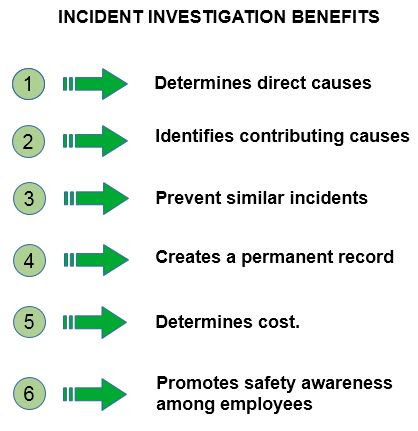
the benefits of incident investigation as follows:
Direct
determination of the causes: An investigation reveals the direct
causes of an incident, allowing corrective measures to be
established.
Identification
of associated factors: Incidents can be the result of many
factors, for example, the direct cause of an incident can be the
inadequate use of protective equipment on the machines, however,
there can also be associated factors, such as the lack of training in
handling equipment.
Prevention
of similar incidents: Once the direct causes and associated
factors are identified, corrective measures such as training programs
or improvements in the design of equipment or workplaces are
implemented to prevent similar incidents in the future.
Creation
of permanent reports: The reports generated in an investigation
can be used by the human resources area and occupational health and
safety specialists to identify trends related to the frequency of
incidents, inadequate plant design and layout, inadequate operating
procedures, etc. Reports are also important in situations where
compensation disputes or claims arise. The actions taken to improve
occupational health and safety records contribute decisively to
adequately allocate monetary, human and equipment resources to the
areas with the highest frequency of accidents or to those where the
effects are most harmful.
Determination
of associated costs: The reports help to understand a certain
situation more precisely and therefore to quantify and determine the
costs associated with the occurrence of an incident. All factors,
including lost time by workers, damage to equipment and machinery,
loss of supplies and materials, etc. they are likely to be
quantified, a task that can be better accomplished from the reports
that are part of the incident investigation.
Promotes
a culture of employee safety: When an incident investigation is
conducted appropriately, it signals to workers that top management
takes occupational health and safety seriously, seeking to maintain
the well-being of employees. The foregoing motivates the company's
workers, regardless of the area where they work or their rank, to
have a greater commitment to good safety and health practices in the
workplace.
Etiquetas:
Batch of one,
Continuos improvement,
Just in time,
Kan-ban,
Manufacturing methodologies,
Process analysis,
Production engineering,
Production systems,
Pull system,
Push system,
Statistical process control
The techniques used in the “pull” production system
The "pull" manufacturing system is characterized by producing only what is required, minimizing inventory in process. To achieve this end, several particular approaches have been created, such as those described below:
Just-in Time: In which only the appropriate components, at the precise moment they are required, are manufactured.
Kan-Ban: It is a paper record that enforces just-in-time, moving with each batch of components. This can be automated using barcodes, QR codes, etc.
Manufacturing cells: Combine the requirements of a variety of products so that a set of equipment can produce each of them, as needed. This mainly applies to manufacturing and sometimes to assembly.
Batch-of-One: Refers to the ability to make any combination of items with a batch size as small as one.
Continuous improvement: Refers to the ability to find ways to improve current processes, often by combining and/or eliminating manufacturing activities.
Statistical process control: Referred to monitoring how well the process is working.
The manufacturing process had played a secondary role in product design for most of the 20th century, resulting in many problems when it came to manufacturing the products. While major aspects of manufacturing processes have been researched and implemented in physical devices for many years, the assembly process had very little beyond the rules of thumb to guide it.
Ideas for improving assembly capability and for designing cost-effective manufacturing systems only began to flourish in the late 1970s. During this period, many individuals and companies began to realize that the most rational course of action involved design. of products and the design of manufacturing systems together, which is called concurrent engineering or simultaneous engineering. A more recent term, which involves the entire company as well as suppliers and customers, is known as collaborative engineering.
Manufacturing methodologies – the pull and push systems
Traditionally, there has been a clear separation between the creation of a product and the means through which it is produced. In much of the 20th century, manual production methods were used in different processes, especially those in which assembly was present. However, many important design decisions were worked on behind a desk.
Between the late 1970s and throughout the 1980s, manufacturing industries of all types and sizes wanted to know how they could replace their manual production methods with better processes. In this way, large companies that produced larger volumes of a product determined that automation was the best solution. In this way robots and other programmable machines were developed. Manufacturing plants of this era were characterized by having work-in-process inventory that took up large amounts of space, creating significant costs that did not generate revenue.
In the 1990s, up to the present day, industries of all sizes need to be agile and flexible, so a new paradigm in the field of production was introduced. This approach means that companies are looking to have the ability to respond to any customer very quickly, while minimizing their costs. Thus, the production philosophy changed from making a stock of some product to manufacturing on demand, which required rethinking the way in which production processes should be carried out.
In this framework, Toyota introduced the approach of producing only what is required, with which the "pull" method replaced the "push" method.
In the “push” production method, each stage of the manufacturing process ran at the highest possible speed, regardless of what happened in subsequent stages, which meant having significant batches of inventory in process. To optimize these processes, elaborate simulation methods were created.
In the "pull" method of production, each stage of the manufacturing process works only when the next stage provides notice that it requires inputs. Viewed another way, each step in the process has a customer, either internal or external, to which it responds. Using this system, inventories in process are minimized, being completely eliminated in many cases. The analysis of such a manufacturing system is much less complex than traditional simulation methods.
Producing only what is required is a fundamental concept of "pull" manufacturing systems, which minimizes in-process inventory. Work is not done in any area until the next level says it is ready for input.
Methods engineering
It includes designing, creating and selecting the best manufacturing methods, processes, tools, equipment, and skills to manufacture a product. When the best method interacts with the best skills and efficient worker-machine relationship exists. Of course, when one method is established, then a standard time for the product can be determined.
Methods engineering definition
We can define methods engineering as the technique for increasing the production per unit of time or decreasing the cost per unit output. Alternatively, it can be viewed as the technique that looks for productivity improvement.
Method engineering implies the following during the history of a product:
- It is responsible for the design of the work center where the product will be produced;
- It is responsible for the continuous improvement of the work center with the purpose of find a better way to produce the product or improve its quality. This analysis is also called corporate reengineering.
- Methods engineering is in constant development because of the technological evolution. In this sense, the improvements in productivity are never ends. Research and development is therefore essential to methods engineering.
The procedure of methods engineering
Methods engineering use a systematic procedure that can be summarized in the following steps:
- Select the project
- Get and present the data
- Analyze de data
- Develop the ideal method
- Present and install the method
- Develop a job evaluation
- Establish time standards
- Follow up the method
Useful definitions related to productivity
There are some terms that are frequently used when we are talking about productivity or methods of performance measurement. These terms are the following:
- Productivity;
- Total factor productivity;
- Production frontier;
- Technical efficiency;
- Feasible production set.
The definition of productivityWe can define productivity of a firm as the ratio of the output that it produces to the input that it uses.When the product process involves a single input and a single output, productivity can be found easily. However, when there is more than one input, which is often the case, then a method for aggregating these inputs into a single index of inputs must be used to obtain a ratio measure of productivity.Total factor productivityWhen we are talking about productivity, generally we are referring to total factor productivity, which is a productivity measure that involves all factors of production. Other measures of productivity, such as labor productivity, fuel productivity and land productivity, are often called partial measures of productivity. These partial productivity measures can provide a misleading indication of overall productivity when considered isolated.Production frontierProduction frontier may be used to define the relationship between the input and the output. The production frontier represents the maximum output attainable from each input level.Technical efficiencyWhen firms operate in the production frontier they are technically efficient.Feasible production setIt is the set of all input-output combinations that are feasible. This set consists of all points below the production frontier. The points along the production frontier define the efficient subset of this feasible production set.
Productivity
and performance measurement
Productivity
is concerned with measuring the performance of firms, which convert
inputs into outputs. An example of a firm is a computer factory that
uses material, labor and capital (inputs) to produce computers
(output). The performance of this kind of factory can be defined in
some ways. For example a basic measure of performance is a
productivity ratio.
What
is a productivity ratio?
It
is the ratio of outputs to inputs, where larger values of this ratio
are associated with better performance.
Note
that performance is a relative concept, because for example, the
performance of the factory in 2021 can be measured relative to its
2020 performance, or 2019, or 2010, etc.
The
methods of performance measurement can be applied to a variety of
firms or “decision making unit”, as can be named in some of the
literature on productivity and efficiency analysis. They can be
applied to private sectors firms producing goods or to service
industries. The methods may also be used by a particular firm to
analyze the relative performance of units within the firm or to
measure the performance in non-profit organizations.
Even
the context of productivity analysis mentioned above involve
micro-level data, the methods can be used for making performance
comparisons at higher levels of aggregation, like the performance of
an industry over time or across geographical regions, and so on and
so forth.
The
methods of performance measurement differ according to the type of
measures they produce, the data they require and the assumptions they
make regarding the structure of the production technology and the
economic behavior of decision makers.
What
are the requirements for performance measurement?
Some
methods only require data on quantities of inputs and outputs while
other methods also require price data and various behavioral
assumptions, such as cost minimization, profit maximization, etc.
What is the importance of productivity and how to improve it
Creating goods and services in different areas requires that certain
resources be transformed into these (raw materials, supplies, labor,
etc.). The more efficiently the mentioned transformation happens, the
more productive it will be.
In its most basic form, productivity can be understood as the
proportion of outputs (goods and services) among the inputs
(resources such as raw materials, inputs, labor, capital, etc.).
Improving productivity it is of vital importance for any company.
Improving the ratio of outputs and inputs (productivity) will be one
of the most important tasks (if not the most important) that
industrial engineering and in general the directors of operations or
production face in their daily work.
How to improve productivity?
Productivity improvement can be achieved in the following ways:
either by reducing the inputs while the outputs are kept constant, by
increasing the outputs while the inputs are kept constant, or by
increasing the outputs and reducing the inputs at the same time. This
implies an increase in productivity.
From the economic perspective, the inputs can be identified as land,
labor, capital and management. These inputs are combined in a
production system. Through management, the conversion of inputs into
outputs can be achieved. The better the management the greater the
productivity that can be achieved in a given production system.
The outputs resulting from a production process can be goods or
services of various kinds (for example computers, calculators, cell
phones, soft drinks, education, hotels, etc.). Production then can be
viewed as all the goods and services produced. The fact of having a
high production may originate from an increasing number of people
working (which can lead to an increase in employment levels), however
this situation does not necessarily imply that there is a high
productivity.
Measuring productivity is a good way to assess a country's ability to
provide and improve the living standards of its inhabitants. The
increase in productivity is closely linked with the improvement in
productive capacity and therefore, in a macro context, it can lead to
an improvement in the standard of living.
Without an increase in productivity, the increase in the benefits
generated by the factors of production (labor, capital, land,
technology, management) implies an increase in prices. Conversely,
when productivity increases, prices tend to decrease since more is
produced with the same amount of resources.
What
is productivity? How to measure and calculate it?
In
general terms productivity can be defined as the relationship between
outputs and inputs.
In
which sectors can be applied the definition of productivity?
This
definition of productivity is generic and applies in an enterprise, a
sector of economic activity or the economy as a whole. Productivity
can be used to asses or measure how much output can be extracted from
a given input.
What
is the mathematical representation of productivity?
Mathematically
productivity may be expressed by.
Example
of how to calculate productivity
A
textile factory works eight hours per day manufacturing 100.000 pants
and 50.000 sweaters a month using 110000 and 75000 square meters of
polyester cloth, respectively. If the pants section of the factory
has 50 workers and the sweaters section 75, we can calculate the
productivity as follow:
Measure
of materials productivity
According
to the formula given before, the materials productivity may be
measured as the relation between the quantity of finished products
and the materials used in the process.
Therefore,
the productivity for the pants and sweaters lines of the factory are:
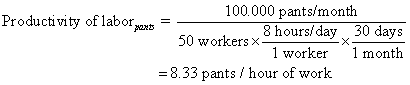
Measure
of labor productivity
The
labor productivity may be measured as the relation between the
quantity of finished products and the labor hours used in the
process.
Therefore,
the productivity for the pants and sweaters lines of the factory are:
The
productivity of any factor of production or input, can be measured in
the form we exemplify before.
The
historical perspective of the industrial revolutions and the
production systems
Since
the industrial revolution during the 19th and 20th
century different production methods have dominated. On an overall
level these methods can be grouped as craftsmanship, mass production
and lean production, each with particular type of technology, work
organization, production solutions, how to handle different product
variants, and quality aspects.
Material
and processes to develop products have a very long history, that is
the case of casting, grinding, and forging which can be dated back
6000 years or more. The first attempts towards factory systems are
described from ancient Rome. The Romans had what could be called
factories to produce weapons, ceramic, glass ware, and some other
products. It was not until the 19th century that real
development towards the production systems of today started, when
what we can call factory systems were developed. This development is
frequently referred to as the industrial revolution.
Starting
with the first industrial revolution in the 18th century,
a big technical development occurred during the 19th and
20th century. The mechanization and automation in
machines, equipment and tools increased tremendously. The
prerequisites for mass production in the 20th century were
covered with machines producing identical components and the
utilization of capacity became an important factor to work with. The
consequences from that were a need to develop new methods for
planning of production, material supply and information.
The
first industrial revolution
It
took place during the period 1760-1830 with important changes that
affect the development of systems to produce products. Inventions
like the steam engine, the use of machine tools and the development
within the textile industry were remarkable. This happened in
parallel with the development of the fabrication system where factory
workers were organized based on new principles for division of labor.
This period also marks the transition from an economy based on
agriculture to an economy based on industrial activities.
A
significant discovery was the principle of division of labor that
consist in the separation of tasks in any system so that participants
may specialize. A great part of the changes carried our during the
19th and 20th century were based on this
principle.
Gradually
a need to coordinate, and also to control, the various operations
emerged and entire production process became centralized and located
in factory areas.
The
second industrial revolution
The
technical background to the development of the assembly system was
the introduction of standardized and interchangeable parts. While
England was leading the industrial revolution, the concept of
interchangeable parts was introduced in the United States. In 1797
Eli Whitney (1765-1825) negotiated with the American government and
received a contract for the production of 10,000 muskets. He believed
he could produce parts accurately enough to permit parts assembly
without fitting of each weapon. In this way the time required for
production could be considerable reduced. After several years of
development in his factory he traveled to Washington to demonstrate
the principle of interchangeable parts.
The
principle of interchangeable parts revolutionized the methods for
manufacturing and constituted a prerequisite for mass production.
Development of specialized production equipment made if possible to
produce identical components for the assembly of complete muskets.
Later on the manufacturing technique spread from the weapons industry
to Singer, the company manufacturing sewing machines.
Ford’s
production system from the early 20th century is often
associated with the introduction of the assembly line in the
manufacturing industry. The first movable assembly line in Ford’s
factory was put into operation in 1913, but technology had been
developed long before.
Key
elements of health and safety management
The
key elements for effective health and safety management are similar
to those considered in good quality, finance and general business
management. The principles of good and effective management provide a
sound basis for the improvement of health and safety performance. The
key elements involved in a successful health and safety management
system are:
Policy
A
clear health and safety policy is essential for business efficiency
and continuous improvement throughout the operation. The
policy should state the decision of the organization in terms of
clear aims, objectives and targets.
Organizing
A
well-defined organization is an essential component of a positive
health and safety culture. An effective organization will be noted
for good staff involvement and participation, high quality
communications, the promotion of competency, and the empowerment and
commitment of all employees to make informed contributions.
Planning
and implementing
An
effective health and safety plan involves the setting and
implementation of performance standards, targets and procedures. The
plan is based on risk assessment methods in order to set priorities
and objectives for the effective control or elimination hazards and
the reduction of risks. Measuring success requires the establishment
of practical plans and performance targets against which achievements
can be identified.
Measuring
performance
Include
both active and reactive monitoring to see the effectivity of the
health and safety management system. Active monitoring involves
looking at the premises, the people, procedures and systems. Reactive
monitoring discovers through investigation of accidents and incidents
why controls have failed. Measure the organization against its own
long term goals and objectives is also important.
Reviewing
performance
The
results of monitoring should be systematically reviewed to evaluate
the performance of the management system against the objectives and
targets established by the health and safety policy. Comparisons
should be made with internal performance indicators and if it is
possible with external performance indicators of similar
organizations.
Costs
of accidents
The
occurrence of any accident will cause both direct and indirect costs.
It is important that all of these costs are taken into account when
the full cost of an accident is calculated. Different studies shown
that indirect costs or hidden costs could be more than 30 times
greater than direct costs of an accident. In other words, the direct
costs of an accident or disease represent the tip of the iceberg when
compared to the overall costs.
Direct
costs
These
are costs that are directly related to the accident and may be
insured or uninsured.
Insured
direct costs, normally include:
- claims
on employers and public liability insurance
- damage
to buildings, equipment or vehicles
- any
attributable production and/or general business loss.
Uninsured
direct costs, normally include:
- fines
resulting from prosecution by the enforcement authority
- sick
pay
- some
damage to product, equipment, vehicles or process not directly
attributable to the accident (e.g. caused by replacement staff)
- increases
in insurance premiums resulting from the accident
- any
compensation not covered by the insurance policy due to an excess
agreed between the employer and the insurance company
- legal
representation following any compensation claim.
Indirect
costs
Indirect
costs are costs which may not be directly attributable to the
accident but may result from a series of accidents.
Insured
indirect costs, typically include:
- a
cumulative business loss
- product
or process liability claims
- recruitment
of certain replacement staff.
Uninsured
indirect costs, can include:
- loss
of goodwill and a poor corporate image
- accident
investigation time and any subsequent remedial action required
- production
delays
- extra
overtime payments
- lost
time for other employees, who attend to the needs of the injured
person
- the
recruitment and training of most replacement staff
- additional
administration time incurred
- lower
employee morale possibly leading to reduced productivity
Some
of the items mentioned above, such as business loss, may be
uninsurable or too prohibitively because of the big amount of money
required.
Basic
definitions related to occupational
health and safety
Some
basic and powerful definitions related to occupational health and
safety are the following:
Health
Related
to the protection of the bodies and minds of people from illness
resulting from the materials, processes or procedures used in the
workplace.
Safety
Related to the
protection of people from physical injury. The borderline between
health and safety is ill-defined and the two words are normally used
together to indicate concern for the physical and mental well-being
of the individual at the place of work.
Welfare
Related
to the provision of facilities to maintain the health and well-being
of individuals at the workplace. Welfare facilities include washing
and sanitation arrangements, the provision of drinking water,
heating, lighting, eating and rest rooms. First aid arrangements are
also considered as welfare facilities.
Occupational or
work-related ill-health
Is concerned with those
illnesses or physical and mental disorders that are either caused or
triggered by workplace activities. Such conditions may be induced by
the particular work activity of the individual or by activities of
others in the workplace. The time interval between exposure and the
onset of the illness may be short or long.
Environmental
protection
Related
to the arrangements to cover those activities in the workplace which
affect the environment and, possibly, the health and safety of
employees and others.
Accident
Defined
as any unplanned event that results in injury or ill health of
people, or damage or loss to property, plant, materials or the
environment or a loss of a business opportunity.
Near miss
Is any incident that
could have resulted in an accident.
Dangerous occurrence
It’s
a near miss which could have led to serious injury or loss of life.
Hazard and risk
A hazard is the
potential of a substance, activity or process to cause harm. Hazards
take many forms including, for example, chemicals, electricity and
working from a ladder.
A
risk is the likelihood of a substance, activity or process to cause
harm. A risk can be reduced and the hazard controlled by good
management.
The difference
between hazard and risk
It
is very important to distinguish between a hazard and a risk – the
two terms are often confused and activities such as construction work
are called high risk when they are high hazard. Although the hazard
will continue to be high, the risks will be reduced when controls are
implemented.
The residual risk
The level of risk
remaining when controls have been adopted is known as the residual
risk. There should only be high residual risk where there is poor
health and safety management and inadequate control measures.
About occupational health
and safety
Occupational health and safety is relevant in all branches of industry,
business and commerce including traditional industries, information technology
companies, care homes, schools, universities, leisure facilities and offices.
Occupational health and safety affects all aspects of work, that’s why high
hazard manufacturing plant requires many different specialists, such as
engineers (industrial, electrical, mechanical and civil), lawyers, medical
doctors and nurses, trainers, work planners and supervisors, may be required to
assist the professional health and safety practitioner in order to ensure that
there are satisfactory health and safety standards.
Generally, there are many obstacles in the process of achieve good
health and safety standards. The pressure of production or performance targets,
financial constraints and the complexity of the organization are typical
examples of such obstacles. However, there are powerful incentives for
organizations to strive for high health and safety standards. These incentives
are moral, legal and economic.
The corporate
responsibility and the relation with occupational health and safety
Corporate responsibility, a term used extensively in our days, covers a
wide range of issues. It includes the effects that an organization’s business
has on the environment, human rights and common welfare. Health and safety in
the workplace is an important corporate responsibility issue.
One
definition of corporate responsibility
Corporate responsibility has various definitions, however, broadly
speaking it covers the ways in which organizations manage their core business
to add social, environmental and economic value in order to produce a positive, sustainable impact on both society and the business
itself. Terms such as corporate social responsibility and socially responsible
business refer to this concept.
In terms of corporate responsibility, organizations must
work in order to:
- improve management systems to reduce
injuries and ill health
- demonstrate the importance of health and
safety issues at board level
- report publicly on health and safety
issues within their organization, including their performance against targets.
Effective management of health and safety:
- is vital to employee well-being
- has a role to play in enhancing the
reputation of businesses and helping them achieve high-performance teams
- is financially beneficial to business.